Prompt Engineering for Business: A Practical Guide

- Business writing benefits from more prompt structure than casual use, since a vague answer costs more when there's a real reader and real stakes.
- Four recurring business-task patterns each need a different emphasis -- impact-framing for self-reviews, "state the ask or say none exists" for summaries, honest structuring for research, and follow-up-based practice for high-stakes conversations.
- Treat anything typed into a prompt the way you'd treat anything typed into a tool you don't fully control -- genericize client names, unreleased figures, and personal data before they go in.
- A shared, tested prompt is worth more to a team than to one person -- consistency across a team's output compounds in a way personal convenience doesn't.
- Generic-sounding output is a sign the prompt needs a tighter constraint tied to the specific input, not a sign the tool has hit its limit.
Most business writing follows a recognizable pattern: turn messy input into a specific, useful output, under a deadline, for a reader who has limited time to engage with it. That pattern is exactly what AI prompts handle well, once the prompt is structured around the actual business need instead of a vague request. This guide covers how the general prompt-writing principles apply specifically to recurring business tasks — not new theory, just the practical application of the same role-task-format-constraint structure to the writing most people actually do at work.
Why business prompts need more structure than casual ones
A casual ChatGPT question can tolerate a vague answer — worst case, you ask a follow-up. Business writing usually has a real reader on the other end (a manager, a client, a colleague who needs something specific from the output) and a real cost to getting it wrong: a self-assessment that undersells real work, a brief that buries the actual decision point, an email that reads as generic. The extra few minutes spent on a properly structured prompt is almost always cheaper than the rework from a vague one.
The four business-task patterns this covers
1. Turning your own work into something that reads well to someone else
Performance reviews, self-assessments, and portfolio summaries all share the same underlying problem: you did the work, but describing it in a way that lands with someone who wasn’t there is a genuinely different skill from doing the work itself. The fix is a prompt that explicitly asks for impact framing, not activity framing — the Performance Review Self-Assessment Prompt is built around exactly this: reframing “I led the migration” into what the migration actually changed.
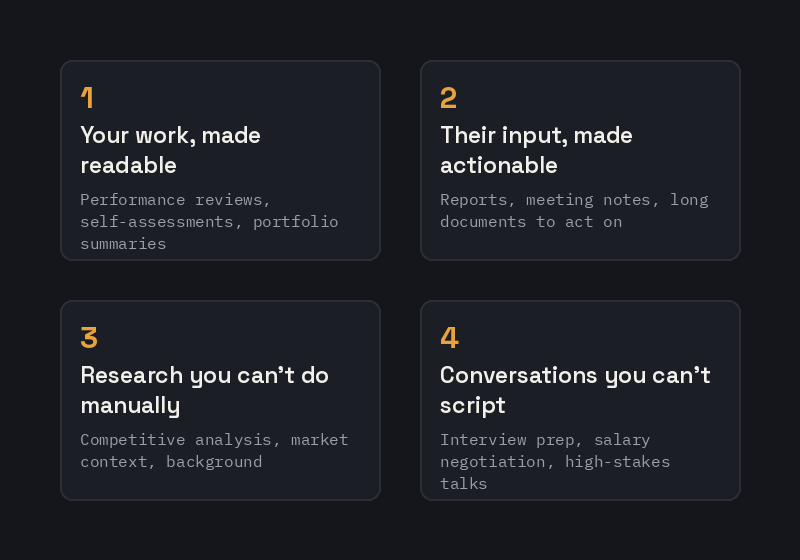
2. Turning someone else’s long input into something you can act on quickly
Reports, meeting notes, and long documents are common inputs that need to become short, decision-focused outputs. The key structural element here is telling the model what to explicitly leave out, not just what to include — background and methodology are usually noise for a busy reader. The Executive Brief Prompt and the meeting-notes-to-action-items prompt below both use this same “state the ask, or state that there isn’t one” constraint, which prevents the single most common failure mode of AI summaries: manufacturing urgency or decisions that aren’t actually in the source material. The Meeting Notes to Action Items Prompt applies the same principle to a more specific, common task — it marks a task “Unassigned” rather than guessing who owns it when the notes genuinely don’t say.
3. Researching something you don’t have time to research manually
Competitive analysis, market context, and background research are tasks where the real value isn’t the AI doing research you couldn’t do yourself — it’s structuring what you already generally know (or could look up) into a format that’s actually usable in a meeting or a document, faster than doing that structuring by hand. The Competitive Analysis Prompt is built around this specifically — it organizes what you already know about a competitor into positioning, strengths, and gaps, and is deliberately instructed not to soften the strengths section into vague praise.
4. Preparing for a conversation you can’t fully script
Interview prep, salary conversations, and other higher-stakes conversations benefit from prompts that generate practice scenarios and likely follow-up questions, rather than a rigid script — since a real conversation won’t follow a script anyway. The goal is building familiarity with the shape of the conversation, not memorizing exact lines. The Technical Interview Practice Prompt takes this further for developer-role prep specifically — it asks genuine follow-up questions based on your actual answer, the way a real interviewer does, rather than working through a static list.
A complete example: from vague request to usable prompt
Vague: “Help me prepare for a meeting about our Q3 numbers.”
Structured: “Act as a business analyst helping me prepare talking points for a Q3 review meeting with my manager. I’ll give you the raw numbers and context. Structure the output as: the single most important trend, 2-3 supporting data points, one thing that might get asked about that I should have an answer ready for, and a suggested opening line that leads with the trend rather than a agenda recap. Numbers: [paste data here].”
The difference isn’t length for its own sake — it’s that the structured version tells the model exactly what shape of output is useful for a meeting (talking points, not a report) and anticipates the one thing that actually matters in meeting prep: being ready for the question that’s coming.
Common mistakes specific to business prompts
- Asking for a summary when what’s actually needed is a decision-framing. “Summarize this report” and “tell me what this report is asking me to decide” produce genuinely different outputs, and the second is usually what a business reader actually needs.
- Not specifying the reader. A brief for a technical peer and a brief for an executive who doesn’t know the technical background need different vocabulary and different emphasis — “write a summary” without specifying who reads it leaves that decision entirely to guesswork, and the model will guess wrong as often as it guesses right.
- Treating research prompts as fact-generators rather than structuring tools. For anything with real stakes — numbers going into a real decision, claims about a competitor — verify anything the model states as fact rather than treating AI output as a research source in itself.
- Forgetting tone constraints for external-facing writing. An internal Slack update and a client-facing email need different registers; if the output needs a specific tone, say so explicitly rather than assuming the model will infer the right one for the audience.
Who this is for
Anyone doing recurring business writing tasks — reviews, briefs, research summaries, interview or negotiation prep — who wants a repeatable, reliable approach rather than starting from a blank prompt each time. The specific prompts referenced throughout this guide are ready to use directly; the underlying pattern is meant to be adapted to whatever similar task comes up next — a new recurring task is usually a matter of asking which of the four patterns above it actually resembles, rather than starting the structure from nothing.
Refining a business prompt through iteration, not just the first draft
The same principle from the foundational guide applies here, with a business-specific wrinkle: it’s often faster to run a rough version of a business prompt once, look at what came back, and refine with a follow-up than to spend real time perfecting the initial prompt before ever testing it. “Make this shorter” or “this needs to sound more urgent given the timeline” are perfectly reasonable follow-ups that fix a close-but-not-quite result. Where this breaks down: if the first output missed the actual point of the task — summarized when a decision-framing was needed, for instance — a follow-up asking for a different tone won’t fix a fundamentally wrong structure. In that case, it’s faster to restate the task clearly than to iterate toward it through several follow-ups.
What not to put in a business prompt
This matters enough to state directly: treat anything typed into a prompt the same way you’d treat anything typed into any other external tool your company doesn’t fully control. Specific client names, unreleased financial figures, personal data about employees or customers, and anything covered by an NDA are all reasonable things to genericize before they go into a prompt — “a mid-size client in the logistics sector” instead of the actual company name, for instance, unless your organization has specifically confirmed the tool and plan you’re using has appropriate data handling guarantees for that kind of information — consumer-tier plans and enterprise/business-tier plans often have meaningfully different data retention and training-use policies, and it’s worth actually knowing which one applies before assuming. This isn’t a reason to avoid AI tools for business work; it’s a reason to build the habit of a quick mental check before pasting something in, the same way you’d pause before attaching a sensitive document to a casual email.
Building a shared prompt library, not just personal ones
A prompt that works well for a recurring task is worth more to a team than to one person — if three people on the same team are all separately writing their own version of a status-update prompt or a client-email prompt, that’s the same problem solved three times with three different levels of quality. Saving a tested version somewhere the whole team can find it (a shared doc, a team wiki page, whatever your team already uses) turns an individual efficiency gain into a team-wide one. This matters more for business use specifically than for personal use, since consistency across a team’s output is often actually valuable in a way that consistency across one person’s casual chat history isn’t.
Worth being specific about what “shared” should mean here: a shared prompt should include the context for when to use it and what to adjust, not just the raw prompt text — otherwise it gets copy-pasted into situations it wasn’t actually built for, and the results quietly degrade without anyone noticing why.
How to know if a business prompt is actually working, not just producing plausible output
AI output for business tasks has a specific failure mode worth watching for: it can read as polished and confident while being subtly wrong or generic in a way that’s easy to miss under a deadline. A useful check, especially for a new prompt you haven’t used many times: does the output actually reflect the specific input you gave it, or could it have been generated from almost any similar-sounding input? A performance self-assessment that could describe almost anyone’s year at almost any company, or a competitive analysis that reads like generic industry commentary rather than something grounded in your specific input, is a sign the prompt needs a tighter constraint — usually more specific instructions about what to draw directly from your input, rather than what general knowledge to fill in around it.
The second check is whether the output would actually survive the reader it’s for. A brief that sounds good in isolation but doesn’t answer the specific question your manager always asks, or a review that describes work well but wouldn’t actually change how a promotion conversation goes — these are real-world signals that the prompt is technically working but not solving the actual business problem. Adjusting for the specific reader, not just for general quality, is usually the fix. This matters more for business writing specifically than for casual use, since a business reader rarely says so directly when an output missed the mark — they just quietly stop trusting the next one, which is a harder problem to notice and fix than an explicit complaint would be.
Further reading: OpenAI’s prompt engineering guide and Anthropic’s published guidance are the primary sources worth bookmarking alongside this guide.
FAQ
Do I need a different prompt structure for every type of business task?
The underlying structure (role, specific task, format, constraints) stays the same — what changes is which constraint matters most for that task. For summaries, it’s usually “state the ask or state there isn’t one.” For reviews, it’s “impact over activity.” Same skeleton, different emphasis.
Should I trust AI-generated research for a business decision?
Treat it as a starting structure, not a verified source — for anything with real stakes, confirm specific facts and figures independently rather than treating the model’s output as already-checked research.
How is a business prompt different from a casual ChatGPT question?
Mainly in how much a vague answer costs you. A casual question tolerates a follow-up if the first answer misses; business writing usually has a real reader and a real cost to getting the framing wrong, which is why the extra structure is worth the time.
Can the same prompt structure work for both an email and a longer document?
Yes, with the format constraint adjusted — the role/task/constraint pattern doesn’t change, but “write this as a 3-sentence email” versus “write this as a structured one-page brief” are different format instructions applied to the same underlying approach.