How to Use ChatGPT for Content Creation: Blog Posts, Social Media, and SEO
- Generic AI content almost always traces back to a generic prompt -- audience, angle, and specific expertise have to be stated, not assumed.
- A reusable prompt library beats rewriting prompts from scratch for every piece -- consistency compounds over a content calendar.
- SEO content built for search engines and AI answer engines uses largely the same structure -- answer-first, well-organized, factually specific.
- One piece of content can be repurposed across formats without starting over each time, if the source piece is structured for it from the start.
- Brand voice consistency across AI-assisted content requires an explicit style reference, not an assumption the model will infer it.
The real gap between AI-assisted content that genuinely ranks and reads well, and AI-assisted content that reads as obviously generic filler, almost never actually comes down to which specific model wrote it — it comes down to whether the person prompting it treated ChatGPT as a first-draft collaborator with real structure and research behind it, or as a magic box that turns one vague instruction into a finished, publishable piece. This guide covers a practical, repeatable workflow for blog writing, social content, and SEO specifically, along with the structural habits that separate content worth publishing from content that reads like it was generated in one shot and never touched again.
Why AI Content Often Reads as Generic (and How to Avoid It)
Generic AI content almost always traces back to a generic prompt — “write a blog post about email marketing” gives the model no real audience, no specific angle, and no actual expertise to draw from, so it naturally defaults to producing the safest, most average, least differentiated version of that broad topic it possibly can. The real fix here is not avoiding AI for content entirely, it is giving the model the exact same level of specificity you would naturally give any human freelance writer: exactly who this specific piece is for, what that reader already likely knows, and what makes this piece genuinely different from the fifty other posts already covering that same broad topic.
The second major cause of generic-feeling content is skipping the planning stage entirely and asking for a finished draft in one shot. A post planned first as a structured outline, then written section by section, consistently reads as more deliberate and better organized than one generated as a single long response to a bare topic request.
A third, less obvious cause worth naming directly: reusing the exact same prompt structure for every single piece regardless of topic, which tends to produce a subtly repetitive rhythm across an entire body of content even when the actual subjects vary widely. Varying the angle, format, or hook style deliberately from piece to piece — the same discipline covered in this site’s guide to writing prompts more broadly — keeps a content library from reading as though it all came from the same assembly line, even when it genuinely was produced with heavy AI assistance throughout.
A Practical Blog Writing Workflow
Always start with a real outline, not a rushed first draft. The Blog Outline Prompt Generator builds a structured outline from a topic, audience, goal, and angle, with specific H2 sections rather than generic placeholders like “Introduction” and “Conclusion” — and it flags which section is the strongest candidate for a featured snippet or AI-answer-engine extraction, which matters increasingly for how content gets found and cited.
Once the outline exists, draft section by section rather than asking for the whole post in one generation. This keeps quality more consistent across a longer piece and makes it far easier to fact-check as you go, since you are reviewing one section’s claims at a time rather than skimming an entire finished draft for errors after the fact. For the meta description that determines whether someone actually clicks through from a search result, the SEO Meta Description Prompt Generator handles the specific character-count and keyword-placement conventions that a generic description request tends to miss.
Writing for Social Media Without Sounding the Same Everywhere
A common mistake is writing one piece of social content and adapting it slightly for every platform, when each platform actually rewards a genuinely different structure. LinkedIn rewards a hook-first opening line and short, line-broken paragraphs; Instagram captions need a hook before the “more” cutoff and hashtags kept separate from the caption body; X/Twitter threads need a stand-alone first tweet that never announces itself as a thread.
This site has a dedicated generator for each of these specific conventions rather than one generic social post template: the LinkedIn Post Prompt Generator, the Instagram Caption/Bio Prompt Generator, and the Twitter/X Thread Prompt Generator. For video content specifically, the YouTube Script Prompt Generator is built around hook-first pacing for the first 5-10 seconds, which matters more for retention than almost any other single structural decision in a video script.
SEO Content That Works for Search Engines and AI Answer Engines Together
Content increasingly needs to satisfy two different kinds of “search” at once: traditional search engine ranking, and being the kind of clearly-structured, directly-answering content that AI answer engines like ChatGPT, Copilot, and Gemini actually cite when someone asks them a question instead of searching directly. The good news is that these two goals overlap far more than they conflict — clear H2 structure, a direct answer early in each section, and genuinely useful, extractable facts serve both audiences simultaneously.
A few specific habits matter for both: answering the core question directly within the first sentence or two of a section rather than building up to it, using specific numbers and concrete facts rather than vague claims, and structuring an FAQ section with direct, complete question-and-answer pairs, since this format in particular tends to get extracted and cited by AI answer engines looking for a clean, quotable answer to a specific question. The SEO Meta Description Prompt Generator and Blog Outline Prompt Generator are both built with this dual audience in mind, not just traditional search ranking alone.
Building a Reusable Prompt Library Instead of Starting Fresh Every Time
Anyone producing content regularly benefits from treating their best-performing prompts as reusable assets rather than one-off requests reconstructed from memory each time. A blog outline prompt that consistently produces well-structured posts, a social caption prompt tuned to your brand voice, an ad copy prompt that reliably respects your platform’s character limits — these are worth saving and reusing deliberately, with small adjustments per use, rather than rewritten from scratch every single time.
The Prompt Library Export/Import tool on this site exists specifically for this — save the prompts that work well for your specific content needs, and export them as a portable backup you can move between devices or share with a teammate producing similar content.
Repurposing One Piece of Content Across Multiple Formats
A single well-researched blog post or long-form piece is usually worth more than one piece of content, and treating it that way saves real time compared to researching a fresh topic for every single social post. Once a blog post exists, it already contains the research, the angle, and the key points needed to generate several genuinely different pieces of content from the same underlying work, rather than starting from a blank page for each one.
A practical repurposing sequence: pull the single strongest insight or surprising fact from the post and build a Twitter/X Thread around it specifically, rather than summarizing the whole post; extract a specific lesson or takeaway for a LinkedIn Post framed around professional insight rather than a link-and-summary; and if the post includes a step-by-step process, that same structure often adapts well into a YouTube Script for a short explainer video. Each of these needs its own dedicated prompt reflecting that platform’s actual conventions, not the same summary pasted three different places, but doing this from an already-researched piece is meaningfully faster than starting each one from scratch.
Working With Images Alongside Written Content
Written content increasingly needs a visual component — a featured image for a blog post, a graphic for a social post, a thumbnail for a video — and the same prompting discipline used for text applies directly to the images supporting it. A generic “create an image for my blog post” request produces the same kind of forgettable output as a generic text prompt, for exactly the same underlying reason: no real subject, style, or mood specified.
The Art Prompt Generator on this site applies the same subject-style-lighting-composition structure covered throughout this site’s content-creation tools to image generation specifically, producing a platform-agnostic prompt that works across whichever image tool you use alongside your writing workflow. Keeping visual style consistent across a series of pieces — the same general palette, mood, or treatment — also tends to make a content series feel more deliberately branded than images generated with a fresh, unrelated style each time.
Measuring What Is Actually Working
It is easy to keep producing AI-assisted content at a steady pace without ever checking which specific pieces or formats are actually performing, and content operations that improve over time tend to be the ones that treat performance data as an input back into the prompting process, not just a report to glance at occasionally. If a particular angle, hook style, or content format consistently outperforms others, that is worth feeding back into future prompts explicitly — naming the specific pattern that worked, rather than hoping to intuitively repeat it.
This applies at both the individual post level and the format level. If LinkedIn posts using a personal-story hook consistently outperform posts using a bold-statement hook for your specific audience, that is a concrete detail worth stating directly in future prompts, not just a vague sense that “personal stuff does better.” Being this specific about what has actually worked, based on real performance rather than assumption, tends to compound over time in a way that generic best-practice advice alone does not.
Common Mistakes That Make AI Content Read as Generic
- Asking for a finished piece with no planning stage first. An outline built before drafting consistently produces a more deliberate, better-organized result than a single-shot generation.
- Using one piece of content across every platform with only minor edits. Each platform has real structural conventions that a lightly-adapted single piece tends to miss entirely.
- Skipping the meta description and treating it as an afterthought. A properly sized, specific meta description meaningfully affects click-through rate from search results, and a generic or truncated one wastes that opportunity.
- Publishing the first draft without fact-checking specific claims. AI-generated content can state something confidently and incorrectly — verifying specific facts, statistics, and claims before publishing is not optional, regardless of how polished the draft reads.
- Never building a reusable prompt library. Reconstructing a working prompt from memory every time wastes time that saving and reusing a proven version would not.
Keeping a Consistent Brand Voice Across AI-Assisted Content
A real concern for anyone producing content regularly with AI assistance is drift — individual pieces reading fine on their own, but the overall body of content slowly losing a consistent voice as different prompts, slightly different phrasing, and different sessions accumulate over time. This matters more for brand or business content than personal content, since inconsistency across a company’s public writing can read as unprofessional even when each individual piece is well-written.
The most reliable fix is building your brand voice directly into a reusable system prompt or standing instruction, rather than describing tone freshly in every individual content prompt. The System Prompt Generator on this site, while built primarily around AI agents and chatbots, applies the same underlying principle just as well to a standing content-voice instruction — stating the tone, what to avoid, and specific voice characteristics once, then reusing that same foundation across every piece of content rather than reconstructing it from memory each time and introducing small inconsistencies along the way.
It also helps to keep a small, explicit reference list of phrases or framings your brand specifically avoids — generic hype language, certain clichés, or a formality level that does not match your actual audience — and include that list directly in your content prompts. This kind of explicit constraint does far more to prevent voice drift than a vague instruction to “sound like us” without stating what that specifically means in practice.
A Realistic Weekly Content Workflow
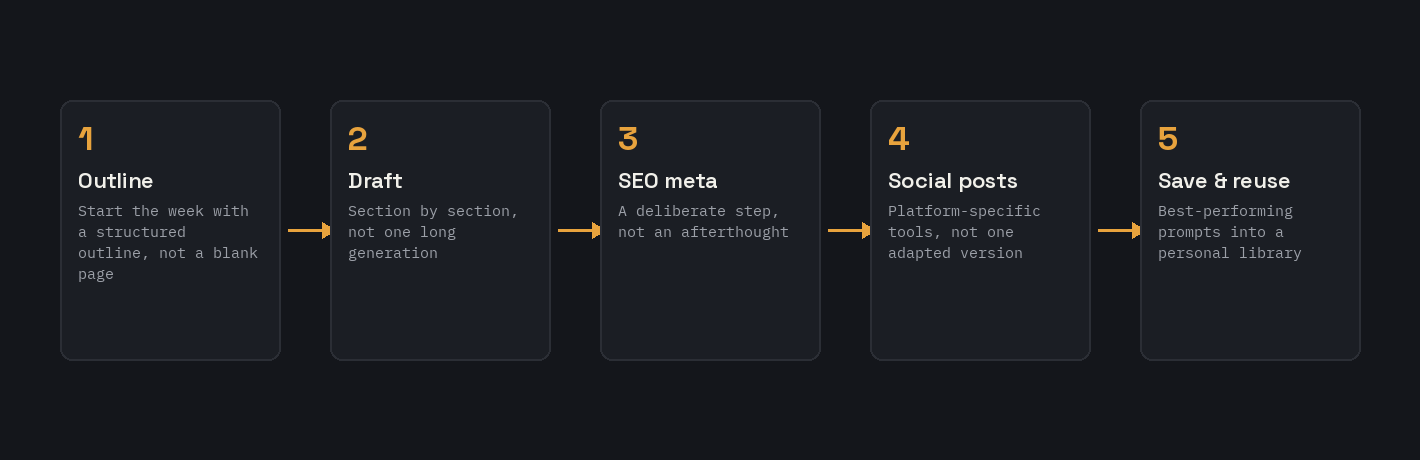
Putting this together into an actual weekly rhythm: start the week by outlining any planned long-form content with the Blog Outline generator, draft each piece section by section rather than in one pass, and write the SEO meta description as a deliberate step rather than an afterthought once the draft is done. For the social promotion around each piece, generate platform-specific posts using each platform’s dedicated tool rather than one adapted version, and save the prompts that produced your best-performing posts into a personal library for reuse the following week.
This kind of repeatable structure is what separates a content operation that gets faster and more consistent over time from one that reinvents its approach from scratch with every single piece, regardless of how capable the underlying AI model is at any given moment. It is also worth building in a brief weekly review of what actually got published against what was planned, since content workflows tend to drift over time without a regular checkpoint — a planned outline that never got turned into a finished post is worth noticing and addressing directly, rather than
Working around ChatGPT’s practical output limits
ChatGPT tends to write shorter per response than a full long-form piece needs — for anything beyond roughly 500-800 words, it’s more reliable to generate section by section (outline first, then expand each section as its own message) than to ask for the entire finished piece in one shot. This isn’t a workaround for a flaw so much as how the tool works best: shorter, focused requests produce more consistent quality than one enormous ask, and it’s easier to catch and fix a weak section before it’s buried in a 2,000-word wall of text.
Using ChatGPT to argue against your own draft
For anything persuasive or research-heavy, a genuinely useful step most people skip is asking ChatGPT to argue the opposing position against what you’ve just written — “what’s the strongest counterargument to this piece” or “what would someone who disagrees say is missing here.” This surfaces gaps and weak claims before a reader does, and it’s a different, more useful prompt than just asking it to “improve” or “strengthen” the draft, since improve/strengthen tends to polish the existing argument rather than pressure-test it.
letting the backlog quietly grow week over week until the whole system feels unmanageable.
Tools for Content Creation on This Site
The core content-creation workflow above draws on the Blog Outline, SEO Meta Description, LinkedIn Post, Instagram Caption/Bio, Twitter/X Thread, and YouTube Script generators, plus the Prompt Library Export/Import tool for saving what works. For product-focused content specifically, the Product Description Prompt Generator and Ad Copy Prompt Generator cover e-commerce and paid promotion respectively. For the underlying prompting discipline behind all of these, the Complete Guide to Prompt Engineering covers the structural principles that make every one of these tools work well.
FAQ
Can AI-written content actually rank well in search?
Yes, when it is planned with real structure, answers the searcher’s actual question directly and specifically, and is fact-checked before publishing — search engines do not penalize AI-assisted content specifically, but they do reward genuinely useful, well-structured content regardless of how it was drafted.
Should I use the same content across every social platform?
No — each platform rewards a genuinely different structure (LinkedIn’s hook-first paragraphs, Instagram’s caption-and-hashtag split, X’s stand-alone thread openers), and adapting only lightly tends to underperform a version built for that platform’s specific conventions from the start.
How much should I edit AI-generated content before publishing?
Always review and fact-check specific claims, statistics, and details before publishing, and adjust anything that does not match your actual voice or knowledge. Treat the AI output as a strong first draft, not a finished, ready-to-publish piece.
What is the single highest-impact change I can make to my content prompts?
Building an outline first, with a specific angle and audience, before asking for any drafted prose. This one habit does more to prevent generic-feeling output than almost any other single change.
How do I make content that AI answer engines like ChatGPT and Copilot are more likely to cite?
Structure content with clear headers, answer the core question directly within the first sentence or two of each section, use specific facts rather than vague claims, and include a genuinely useful FAQ section with direct, complete answers.