OpenAI Cut GPT-5.6 Luna’s Price 80% — What Actually Changed

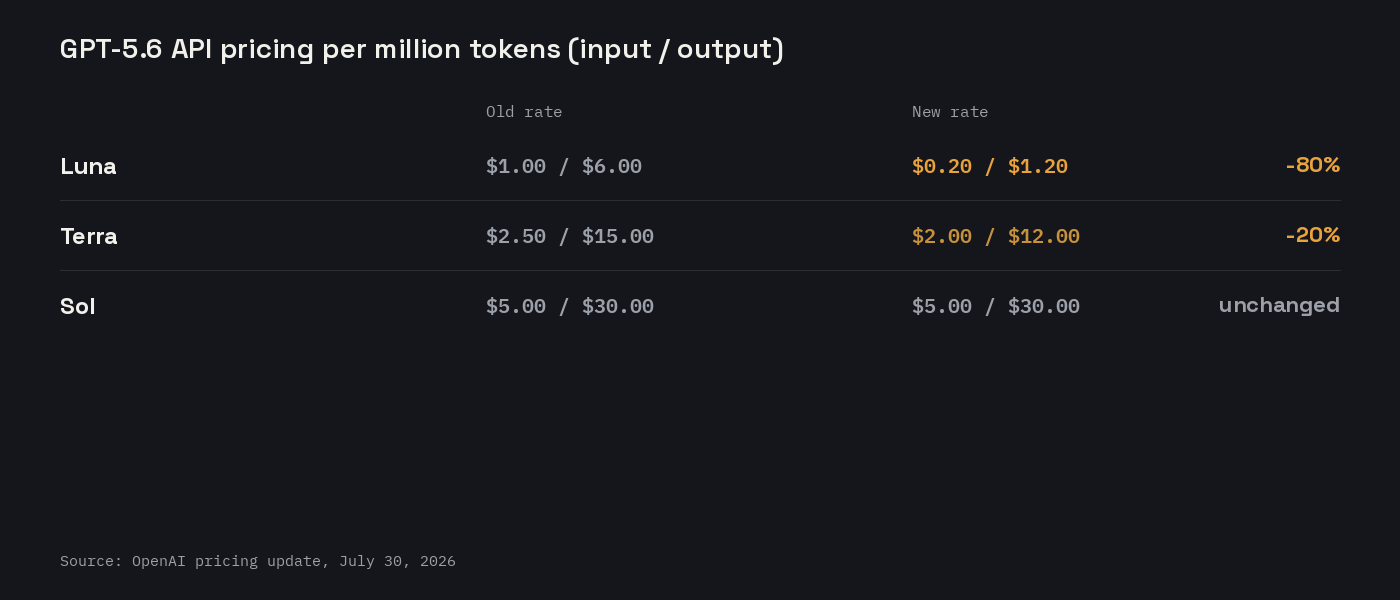
- GPT-5.6 Luna's price dropped 80%, from $1/$6 to $0.20/$1.20 per million tokens, on July 30.
- OpenAI attributes the cut to genuine efficiency work -- Sol autonomously optimizing production GPU kernels, not just competitive pressure.
- Luna now undercuts DeepSeek V4 Pro on input price, but DeepSeek remains cheaper on output -- which one's actually cheaper depends on your usage ratio.
- Sol's pricing (the flagship, reasoning-focused tier) is unchanged -- this cut is specific to the low-cost tier, not the whole lineup.
- The bigger, more durable trend is the gap between "cheap" and "capable" narrowing consistently, not any single price cut.
OpenAI cut GPT-5.6 Luna’s API price by 80% on July 30 — from $1.00/$6.00 down to $0.20/$1.20 per million input/output tokens. GPT-5.6 Terra, the mid-tier model, dropped 20%, from $2.50/$15 to $2.00/$12. The flagship Sol model was left untouched at $5/$30, and instead got a new “Fast Mode” option: 2.5x the processing speed at twice the price, with no change in intelligence according to OpenAI.
What actually drove the cut
OpenAI’s own explanation is specific rather than vague: GPT-5.6 Sol was used to autonomously rewrite and optimize the production GPU kernels serving these models, cutting end-to-end serving costs by 20%, and separate experiments improved token-generation efficiency by more than 15%. Whether or not competitive pressure from cheaper models also played a role, the efficiency explanation is at least a specific, checkable claim rather than just “prices went down.”
Where this leaves Luna relative to the rest of the market
At $0.20 per million input tokens, Luna now undercuts DeepSeek V4 Pro’s promotional input price of $0.435 — notable given DeepSeek’s own aggressive pricing has been a major part of the recent cost story in this space. On output tokens, though, DeepSeek remains cheaper at $0.87 versus Luna’s $1.20, so which is actually cheaper depends on your specific input-to-output ratio, not just the headline input number. Worth noting too: this same week, Claude Sonnet 5’s introductory pricing ($2/$10) is set to expire August 31 and move to $3/$15 — a very different trajectory from Luna’s cut, and worth factoring in if you’re actively comparing options right now.
What this actually changes for how you’d use it
Luna was already positioned as the fast, low-cost tier of the GPT-5.6 lineup — built for high-throughput, low-latency tasks like summarization, classification, and lightweight assistants, not complex reasoning. The price cut doesn’t change what Luna is good at; it changes the calculation for whether routing a given task to Luna instead of a pricier model is worth the tradeoff. A practical pattern several teams are already using: route the parts of a workflow that need real reasoning to Sol, and route the repetitive, clearly-scoped parts — implementing a defined change, running tests, formatting output — to Luna, since at this price the cost difference between routing everything through a flagship model versus splitting the work is now substantial.
What this doesn’t change
Sol, the model actually built for complex reasoning and agentic tasks, kept its pricing entirely unchanged. If your work is reasoning-heavy rather than high-volume-and-repetitive, this specific price cut doesn’t directly affect your costs — it’s a change to the economics of the low-cost tier specifically, not a broad repricing of the whole lineup. It’s also worth being clear-eyed about vendor framing here: OpenAI’s own benchmark claims that Luna delivers performance “competitive with older frontier systems” are the company’s own claims, not independently verified, and are worth treating as a starting point for testing rather than a settled fact.
How to actually decide if this matters for you
The same approach that applies to any pricing change like this: take a real, representative example of what you’d actually send to the model, and check what it would cost under both the old and new pricing for your actual token volume, not a generic example. If your usage is genuinely high-volume and the tasks are the kind Luna is built for, this is a meaningful cut worth acting on. If you’re doing occasional, complex reasoning work, this specific change is mostly interesting context rather than something that changes your bill.
A concrete comparison, so the savings aren’t abstract
Take a workload processing 5 million input tokens and generating 500,000 output tokens per day — a reasonable size for an active classification or summarization pipeline. At the old Luna pricing ($1/$6 per million), that’s $5 for input and $3 for output, totaling $8/day. At the new pricing ($0.20/$1.20), the same workload costs $1 for input and $0.60 for output — $1.60/day, an 80% reduction matching the headline rate exactly, since (unlike the Claude Sonnet 5 tokenizer change covered here previously) this is a pure price change with no change to how the tokens themselves are counted.
Over a month, that’s the difference between roughly $240 and $48 for this specific workload — a real number, not just a percentage, and worth actually calculating against your own volume rather than trusting the 80% figure to mean the same dollar amount it would for a different-sized workload. The AI Cost/Token Estimator is a reasonable way to run that calculation against your own actual usage rather than a generic example.
The pattern worth watching, beyond this one cut
This is the second notable pricing move covered here in as many weeks — DeepSeek’s V4 Flash launch pricing, and now this Luna cut, both pointing the same direction: the cost of routing high-volume, lower-complexity work to a capable-but-not-flagship model keeps dropping, while flagship-tier pricing for the hardest reasoning tasks has stayed comparatively stable across providers. That’s a more durable trend than any single price cut, and it’s worth factoring into how workloads get architected going forward — treating “which model handles this specific task” as a question worth revisiting periodically, not a decision made once and left alone.
FAQ
Is GPT-5.6 Luna now cheaper than DeepSeek?
On input tokens, yes — $0.20 versus DeepSeek V4 Pro’s promotional $0.435. On output tokens, DeepSeek remains cheaper at $0.87 versus Luna’s $1.20, so the actual cheaper option depends on your specific input-to-output token ratio.
Did GPT-5.6 Sol’s pricing change too?
No — Sol’s pricing is unchanged at $5/$30 per million tokens. It did gain a new optional “Fast Mode”: 2.5x speed at double the price, same stated intelligence.
What actually caused the price cut, according to OpenAI?
The company says GPT-5.6 Sol was used to autonomously rewrite and optimize the production GPU kernels serving these models, cutting serving costs by 20%, plus separate efficiency gains of over 15% in token generation.
Should I switch my whole workflow to Luna because of this?
Only for the parts of your workflow Luna is actually suited to — high-volume, low-complexity tasks. It’s not built for complex reasoning, and routing reasoning-heavy work to it to save money would likely cost more in output quality than it saves in tokens.